Same science.
Structured to end.
PainApp and Relief both use pain reprocessing therapy principles backed by peer-reviewed research. The difference: PainApp charges every month with no endpoint. Relief is one payment. 42 sessions. Then you delete it.

Free to try
Where PainApp gets it wrong.
PainApp uses pain reprocessing therapy. The science is sound. But the delivery undermines the principles it claims to follow.
PainApp includes a tracker that logs frequency, intensity, and triggers. This directly contradicts the core insight of pain reprocessing therapy: that focusing on pain reinforces the brain's threat signal. You cannot retrain your nervous system to feel safe while simultaneously scoring your pain every day.
PainApp's AI coach answers questions and guides exercises on demand. But pain retraining is a structured progression, not a conversation: education first, then sensation tracking, then graded exposure, then safety behavior withdrawal. Each stage builds on the last. A chatbot cannot sequence that.
PainApp offers ongoing daily practices and condition-specific courses with no defined completion point. Pain reprocessing therapy works because it teaches your nervous system something new. Once learned, the program should be over. An app that never ends is selling engagement, not recovery.
PainApp bills you every month, or every quarter on the other plan. Either way, the business model has no financial incentive for your recovery. Read the full manifesto.
42 sessions. Then delete the app.
Relief uses the same peer-reviewed pain reprocessing principles as PainApp: pain neuroscience education, sensation tracking, graded exposure, safety behavior withdrawal. The difference is that Relief delivers them as a structured program with a beginning, middle, and end.
No AI chatbot. No pain tracker. No open-ended daily practices. You open the app, press start, and do today's session. 5 to 10 minutes. Each session builds on the last across 6 chapters. When you finish chapter 6, the program is over. The intended outcome is that you delete the app because you no longer need it.
Press play. Follow along.
No menus, no content library to browse, no decision fatigue. You open the app, press play, and the program guides you through day by day.
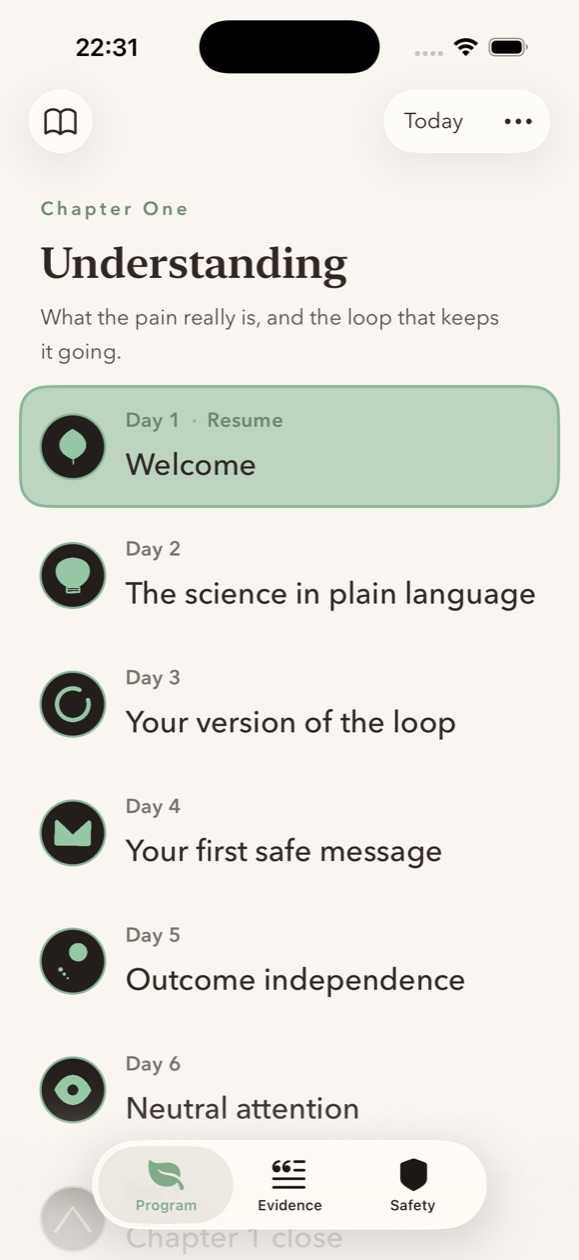
PainApp vs Relief
| PainApp | Relief | |
|---|---|---|
| Approach | Pain Reprocessing Therapy | Brain-based pain retraining (PRT principles) |
| Structure | Ongoing courses, no endpoint | 42 sessions, 6 chapters |
| Session length | Varies | 5 to 10 minutes |
| Coaching | AI chatbot | Listen or read, human-designed |
| Pain tracking | Yes (frequency, intensity, triggers) | No. Focusing on pain creates more pain. |
| Endpoint | None. Subscription continues. | Session 42. Then delete. |
| Payment | Monthly or quarterly subscription | One payment |
| Auto-renewal | Yes | No. Nothing to cancel. |
| Data collected | Account, email, pain data | No account. No email. No tracking. |
When PainApp might suit you.
If you want an AI coach you can talk to about your pain, PainApp offers that and Relief does not. Some people find it helpful to have an on-demand conversation partner during difficult moments, and PainApp's chatbot is trained specifically on pain reprocessing techniques.
PainApp also offers condition-specific courses, which may feel more personalized if you want content tailored to your particular diagnosis.
Relief is for the person who wants structure over flexibility. A program designed by a human, not generated by a model. One session today, sequenced from start to end, at a price you pay once and never think about again.
Common questions
Is Relief a good alternative to PainApp?
If you want a structured pain retraining program without a monthly subscription or AI chatbot, yes. Relief delivers 42 sessions of pain neuroscience education, sensation tracking, graded exposure, and safety behavior withdrawal, one payment. PainApp uses similar principles but charges every month with no defined endpoint.
What is the difference between PainApp and Relief?
Both apps use pain reprocessing therapy principles. PainApp offers an AI coach, pain tracking, and condition-specific courses as an ongoing subscription. Relief is a finite 42-session program with structured progression across 6 chapters, no AI chatbot, and no pain tracking. Relief is designed to be completed and deleted.
Does PainApp track pain? Does Relief?
PainApp includes a pain tracker that logs frequency, intensity, and triggers. Relief deliberately excludes pain tracking. Modern pain neuroscience research suggests that monitoring pain reinforces the brain's threat-detection system. Relief is designed to redirect attention away from pain, not toward it.
Curable · Pathways Pain Relief · Lin Health · Kaia Health · Calm for pain · See all
One payment.
Finish it. Then delete it.
42 sessions. Same science. No subscription. No chatbot.
Free to try