Meditation helps with stress.
It doesn't retrain pain.
If you are using Calm to manage chronic pain, you are using a meditation app for a neuroscience problem. Relief is a 42-session pain retraining program built specifically for chronic pain. One payment.

Free to try
Where Calm falls short for pain.
Calm is a beautiful app. The production quality is excellent. The meditations are well-made, and the sleep stories are genuinely useful for people who need them. But Calm is not a pain app. It was not designed for chronic pain, and using it for pain is like using a flashlight as a hammer: it sort of works, but it is the wrong tool.
Calm does not teach you why chronic pain persists after tissue heals. It does not explain learned neural pathways, threat-detection systems, or the fear-avoidance cycle. Understanding how pain works is the foundation of pain retraining, and Calm does not touch it.
Sensation tracking, graded exposure, safety behavior withdrawal: these are the techniques that research shows can retrain a pain response. Calm offers body scans and breathing exercises, which are helpful for relaxation but do not address the underlying learned pattern. Relief includes its own focused breathing tool for flare-ups, so you get that benefit built in without needing a separate app.
Calm has thousands of meditations, sleep stories, and soundscapes. For someone in chronic pain, that is decision fatigue, not abundance. There is no structure. No progression. No one telling you what to do today or when you are finished.
Calm charges every year and auto-renews. You are paying a premium subscription price for content that was not designed for your condition.
Built for pain. Not adapted from meditation.
Relief is a 42-session program built from the ground up for chronic pain that does not match the tissue story. Every session addresses the nervous system directly. Pain education, then sensation tracking, then graded exposure, then safety behavior withdrawal. Each session builds on the last.
No meditation library. No sleep stories. No soundscapes. Just the peer-reviewed protocol for retraining a pain response, delivered in 5 to 10 minutes a day, with a clear endpoint. And when pain flares, a one-tap breathing exercise to get you through it: 60 seconds, free, always available.
Press play. Follow along.
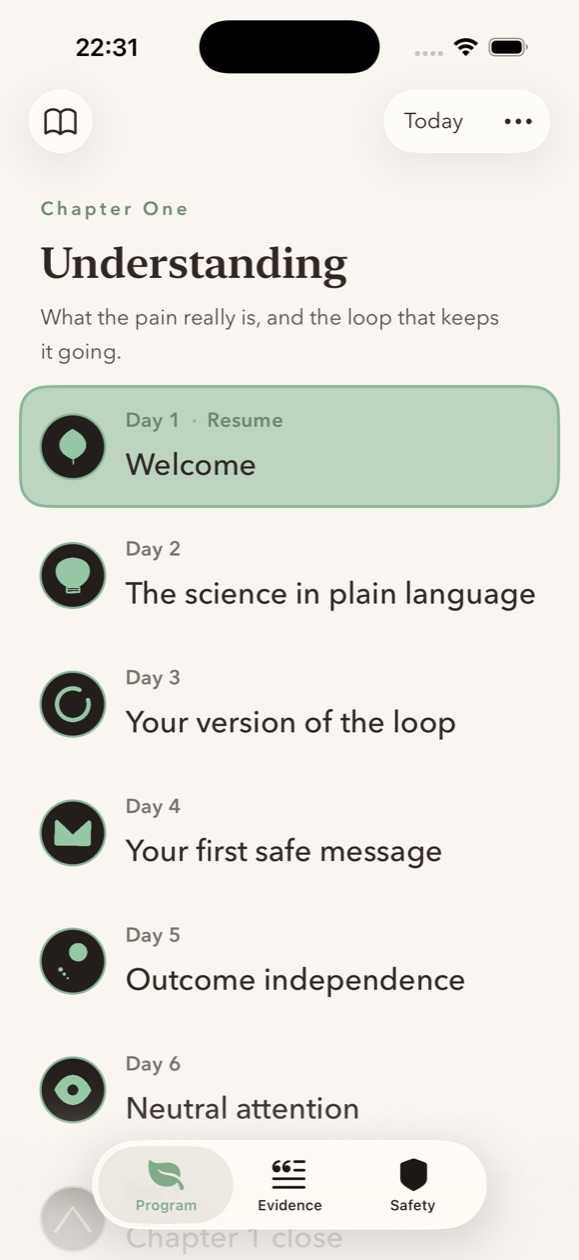
No menus, no content library to browse, no decision fatigue. You open the app, press play, and the program guides you through day by day.
Calm vs Relief
| Calm | Relief | |
|---|---|---|
| Designed for | Meditation, sleep, relaxation | Chronic pain retraining |
| Pain neuroscience | None | Core of the program |
| Pain retraining | None | Sensation tracking, graded exposure |
| Structure | Open-ended library | 42 sessions, 6 chapters |
| Content | Thousands of meditations | One session per day, chosen for you |
| Session length | Varies (3 to 45 minutes) | 5 to 10 minutes |
| Breathing / flare-ups | General breathing exercises | One-tap breathing for pain flare-ups. Free. |
| Endpoint | None. Subscription continues. | Session 42. Then delete. |
| Auto-renewal | Yes | No. Nothing to cancel. |
When Calm is the better choice.
If your primary goal is stress reduction, better sleep, or a daily meditation practice, Calm is excellent at what it does. The production quality is unmatched, the content library is vast, and the sleep stories are genuinely helpful for millions of people.
Meditation is also a legitimate complement to pain retraining. If you already use Calm and find it helpful for the stress and anxiety that amplify your pain, there is no reason to stop. But Relief already includes a focused breathing exercise for flare-ups: short, free, and designed specifically for pain moments. For many people, that covers the breathing and calming benefit without a second subscription.
But if you are using Calm as your primary pain management strategy, you are using a general wellness app for a specific neuroscience problem. Relief was built for that problem.
Calm vs Relief for pain
Is Relief a good alternative to Calm for chronic pain?
If you are using Calm specifically to manage chronic pain, yes. Calm is a general meditation app with no pain-specific program, no pain neuroscience education, and no pain retraining protocol. Relief is built specifically for chronic pain: 42 sessions of brain-based pain retraining, one payment.
Can meditation apps like Calm help with chronic pain?
Meditation can help with the stress and anxiety that amplify chronic pain. Body scan meditations in particular can build awareness of sensation without judgment. But meditation alone does not address the learned neural patterns that maintain chronic pain. Pain retraining requires specific techniques: pain neuroscience education, sensation tracking, graded exposure, and safety behavior withdrawal. Relief also includes a focused breathing exercise for flare-ups, so you get the core calming benefit without needing a separate meditation subscription.
Is Relief cheaper than Calm?
Relief is one payment with no subscription and no auto-renewal. Calm charges every year and auto-renews, so the cost keeps adding up for an app that was not designed for pain.
Curable · Pathways Pain Relief · Lin Health · Kaia Health · PainApp · See all
One payment.
Finish it. Then delete it.
42 sessions of brain-based pain retraining. Built for chronic pain.
Free to try