No insurance needed.
No waitlist.
Lin Health offers coach-led pain recovery, but requires US insurance or a monthly self-pay subscription. Relief delivers brain-based pain retraining, one payment. Download and start today.

Free to try
Where Lin Health loses people.
Lin Health has the strongest clinical model in the space: a dedicated personal coach, physician oversight, and a multidisciplinary team. The problem is access, not the approach.
If your insurance does not cover Lin Health, you pay a self-pay subscription, billed every month, with coaching plans costing more. Even the cheapest annual plan renews year after year. That adds up fast.
Lin Health's insurance model limits it to the United States. If you are outside the US, self-employed without qualifying coverage, or between plans, Lin Health is not an option.
You cannot just download the app and begin. Lin Health requires insurance verification, a physician enrollment process, and coach matching before your first session. For someone in pain today, that delay can feel like another barrier.
Coach matching is automatic. Users have reported difficulty switching coaches when the fit was not right. The therapeutic relationship matters, and not having a say in it is a meaningful limitation.
Download. Start. Today.
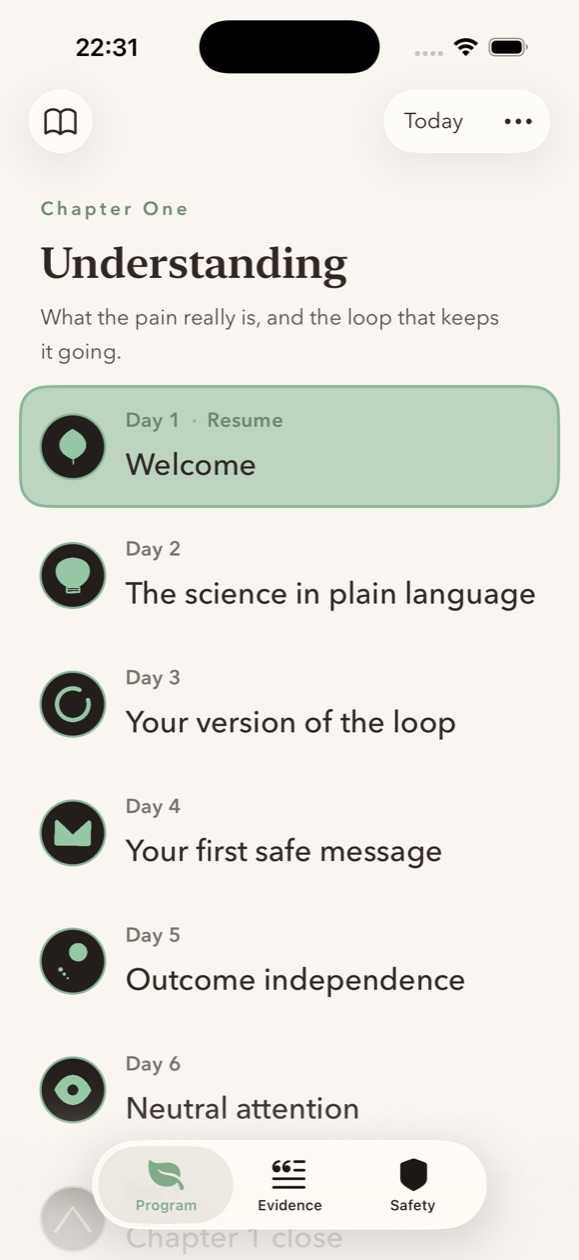
Relief uses the same research foundation as Lin Health: pain reprocessing therapy, pain neuroscience education, graded exposure. The difference is that Relief trades human coaching for radical accessibility.
No insurance verification. No physician enrollment. No waitlist. No geographic restrictions. One payment, on the App Store, available worldwide. The first session is free. You can start in the next five minutes.
Press play. Follow along.
No menus, no content library to browse, no decision fatigue. You open the app, press play, and the program guides you through day by day.
Lin Health vs Relief
| Lin Health | Relief | |
|---|---|---|
| Approach | Coach-led brain-based recovery | Self-guided pain retraining |
| Coaching | Weekly 1-on-1 video sessions | Listen or read, self-paced |
| Medical oversight | Yes (physician review) | No. See your doctor separately. |
| Structure | 3 to 6 months, coach-directed | 42 sessions, 6 chapters |
| Availability | US only, insurance-dependent | Worldwide, anyone |
| Time to start | Days to weeks (onboarding) | Minutes |
| Payment | Insurance or monthly subscription | One payment |
| Data collected | Full medical intake | No account. No email. No tracking. |
When Lin Health is the better choice.
If your insurance covers Lin Health, the value proposition is hard to beat: a dedicated personal coach, weekly video sessions, physician oversight, and a multidisciplinary team at no out-of-pocket cost. That is a premium level of care.
If you feel you need human guidance, accountability, and a coach who knows your specific situation, Lin Health offers something Relief cannot. A self-guided program is not a substitute for a therapeutic relationship when that is what the situation requires.
Relief is for the person who cannot access Lin Health, cannot afford an ongoing subscription, is outside the US, or simply wants to start now with a structured program they can do on their own terms.
Common questions
Is Relief a good alternative to Lin Health?
If you cannot access Lin Health through insurance, are outside the US, or want to start immediately without onboarding calls, yes. Relief uses the same brain-based pain retraining principles, one payment. Download and start in minutes.
What is the difference between Lin Health and Relief?
Lin Health is a coach-led program with weekly video sessions, a dedicated personal coach, and physician oversight. It requires US insurance or a monthly self-pay subscription. Relief is a self-guided 42-session program, one payment, available worldwide. Both use brain-based pain retraining. Lin Health adds human coaching. Relief trades coaching for accessibility.
Is Lin Health free?
Lin Health is free if your insurance covers it, primarily in Colorado, Texas, Florida, California, and New York. Without qualifying insurance, it is a monthly self-pay subscription. Relief is one payment for everyone, regardless of insurance or location.
Curable · Pathways Pain Relief · Kaia Health · PainApp · Calm for pain · See all
One payment.
Finish it. Then delete it.
42 sessions. No insurance. No waitlist. Available worldwide.
Free to try